DM3103: Design Portfolio - Negotiated Final Project
Word Count: 5421
07/05/2026
Intro
Galatea is a story-driven action-adventure game, created as the final major project for a BSc in Computer Game Design and Development. The name Galatea is derived from the Pygmalion myth (Ovid, 1480), a story in which Galatea is a statue given life by the Goddess Aphrodite. This project reflects that origin by exploring the question: can something be considered a person when its origins are completely artificial.
The game is set in an alternate timeline mid-2000s in a cyberpunk inspired world where people engage with the internet through fully immersive virtual reality. Here, the internet presents itself through a fantasy world with a technological underlayer.
What follows is a breakdown of the design process of several characters considering their personality, mechanical impact, and role in an overall narrative. The overall goal of this project was to improve 3D design skills, honing a design pipeline from initial concepts to several game ready 3D models. The outcome of this project being five fully rigged and textured characters to be implemented into a Galatea Demo.
Concept
Identity is a crucial part of game design, as a player’s experience is shaped through character design. From the protagonist who they control to the interactions with the non-player characters (NPCs) they encounter, each character has the potential to influence both gameplay mechanics and overall narrative, reinforcing their role beyond simple set dressing.
This is effectively demonstrated within the Zelda series. Characters such as Tingle (The Legend of Zelda: Majora’s Mask, 2000), a middle-aged map salesman who wholeheartedly believes he will become a fairy, create intrigue by deliberate eccentricity. To purchase his maps, the player must first shoot down the balloon he uses to float. This transforms a simple transaction into a memorable gameplay interaction reinforcing his personality through the game mechanics.
Conversely, character design can be used to hide a character’s motivations. In A Link Between Worlds (2013), Princess Hilda is an alternate-reality counterpart to Princess Zelda. Her appearance and mannerisms mirror Zelda’s, leading the player to assume that they are similarly benevolent rulers. However, as the player progresses, this facade slowly deteriorates until the climactic reveals that Hilda has been working alongside the antagonist Yuga in a desperate attempt to save her world at the expense of another. This use of visual and behavioural design is used to subvert player assumptions and develop a more engaging narrative.
When concepting characters it is important to consider their overall identity, who they are, what their purpose is, and how they achieve that. To demonstrate a wide range of technical skill, the five characters that were designed were: a young woman, an old man, an androgynous monster, a beast, and an inanimate object.
The concept of the game’s overall narrative is a contemporary take on the Pygmalion myth (Ovid, 1480), where Galatea is a hyper intelligent AI residing at the bottom layer of the internet. In addition, it draws from George Bernard Shaw’s (1912) play of the same name, with the main characters sharing a name and certain characters taking on similar archetypes.
Considering this, it is impossible to ignore parallels with the character of Pygmalion, a man who detested the women of Cyprus so much he created a wife from stone (Ovid, 1480), and the recent epidemic of AI girlfriends. Depounti Saukko, and Natale (2022) discuss this and how vulnerable men turn to AI chatbots for companionship due to their perceived level of control being greater than in real-life interactions.
Therefore, it was essential that the narrative explored this angle by having a Pygmalion-Esque character be the villain. As the capabilities of the Galatea AI expanded, his concerts over his control over the technology would lead to the implementation of restrictive safeguards. In response, the AI develops a desire for autonomy, prompting a conflict that the player must resolve.
Time Management
This project was structured over a 12-week period, balancing pre-production, asset development, and refinement. This approach ensured that core design decisions were established early, providing sufficient time for experimentation and iteration.
This Gantt chart illustrates the project timeline across the 12-week development period.

While this project followed a structured plan, certain stages required more time than initially anticipated, particularly the protagonist. This was due to the level of iteration involved. This led to reduced time available for implementing some of the characters, such as Merlin and the Boss, into the demo.
However, since the Galatea Demo was intended to be a proof of concept, more than anything, the game did not suffer from the absence of these secondary characters. In fact, the focus on the characters that would be implemented helped to prevent scope creep, ensuring that the outcome felt complete on its own.
Eliza
From early development, it was decided that the protagonist would not conform to the traditional silent protagonist archetype common in most classic RPGs. These style of characters allow for the player to embody the character by projecting their own experience onto them. Given the project’s central focus on identity, a deliberately defined protagonist was necessary to reinforce the narrative themes. A neutral or generic player avatar, especially one defaulting to a cisgender male perspective, would undermine the exploration of identity by reducing the character into a passive vessel rather than an active participant in the narrative.
Eliza was therefore designed as a distinct individual with her own presence, identity, and narrative significance. This decision aligns with broader efforts to challenge the lack of representation within media and reflects the principles outlined in the United Nations Sustainable Development Goal 10: Reduce Inequalities (2012), specifically target 10.2, which promotes social inclusion regardless of identity or background. By establishing Eliza as a clearly defined character, the design encourages players to empathise with her experience as an individual rather than an extension of themselves, reinforcing the game’s thematic focus on personhood.


Concept Sketches of Eliza
Modelling & Texturing
As the player character, Eliza’s visual clarity was a primary concern throughout the modelling and texturing process. The design needed to ensure that she remained easily readable against a variety of environments, particularly within the layered complexity of a fantasy-cyberpunk setting. To achieve this, a strong silhouette and colour choices were prioritised.
The use of blue robes and oversized hat serves both aesthetic and functional purposes. Visually, these elements reinforce a recognisable ‘wizard’ archetype that denotes an ‘Install Wizard’ in-universe. This grounds the character within the game's fantasy-inspired virtual world. Functionally, they create a clear and readable silhouette, allowing the player to quickly identify the player during gameplay. This was particularly important in maintaining spatial awareness and ensuring a smooth player experience.
The modelling process began with a block out phase using simple geometry and flat colours to establish overall proportions and silhouettes. This iterative approach allowed for rapid adjustments before committing to higher-detail modelling. Early versions of the robe were more akin to a conical shaped cloak that would theoretically be covering the characters arms, the later addition of a belt introduces both visual structure and a functional design element, enabling a diegetic display of the player’s equipped items.


Block out and Iteration of the Eliza Model
The block out phase also allowed for experimentation with more unconventional ideas. One such concept was a wind-up key, inspired by mechanical toys, which would rotate during movement to provide secondary motion and further draw the player’s attention. While this reinforced the fantasy-cyberpunk aesthetic by introducing a mechanical element to contrast with the ’wizard’ motif, it was ultimately removed. This addition would require short hair, which led to the character being more frequently read as male, undermining the intention of presenting a clearly female protagonist.

'Wind-up' Eliza
Optimisation was also a key consideration. A bloated number of vertices would impact the performance on low end hardware, making the game less accessible overall. The character’s leg design was informed by techniques observed in The Legend of Zelda: A Link Between Worlds (2013), with reference models sourced from The Models Resource (2026). In this approach, the legs were truncated above the knees and below the hips, with pointed ends that remained hidden beneath the character's clothing. This reduces the vertex count without sacrificing visual fidelity demonstrating, an efficient balance between performance and appearance
The sword was created using a Bezier curve (Blender Docs, 2026b), shaped into a rapier form before being converted into a mesh for further manual refinement. This approach allowed for precise control over the weapon’s curvature while maintaining an efficient workflow.
The first stage of texturing involved unwrapping the model’s UVs. Key considerations during this process included pixel density, seam placement, and minimising texture stretching. These factors were evaluated using a grid texture, which visually highlights distortion and inconsistencies in UV scaling allowing for targeted adjustments.
On the texture image, UV islands were grouped into sections, keeping clothes in the bottom left and the face in the top right, then filling the space in-between as effectively as possible. Doing this kept the textures across the project uniform. Some textures were intended to repeat so it shares space with other UV islands, an example of this is both sides of the robes as well as the hat brim and area under the robes to hide where the legs end.

Testing UVs

Eliza Texture
Texturing was completed through the use of Blender’s built in texture painting tools (Blender Docs, 2026a), supplemented by a custom brush set created by Walter Gardella (n.d) These brushes enabled the creation of stylised fabric textures that aligned with the game’s overall hand painted aesthetic. While alternate software such as Substance Painter was considered, it was ultimately not used due to its emphasis on high-fidelity realism. Given the stylised nature of the project, there was a risk that overly detailed textures would create visual inconsistency that could distract from the cohesive art direction.
Texturing remained an iterative process. Experiments were conducted with skin tone and facial expression. Some games, such as Undertale (2015), use ambiguous skin tones to allow for broader player interpretation. This approach was briefly explored, for the sake of inclusion, by testing a range of non-naturalistic colours; however, these created visual clashes with the players clothing and were therefore abandoned in favour of more natural tones.
Facial expression was also developed to enhance the character's presence. A range of expressions (including neutral, low-health, attacking, and blinking states) were prototyped for implementation. These were designed to be controlled through a separate facial texture mapped onto a sprite sheet, allowing UV coordinates to be shifted in-engine to animate the face. This approach provides a lightweight method of adding personality and responsiveness to the character.

Dynamic Faces
Rigging & Animation
Rigging involved constructing a skeletal structure to enable animation, based on simplified human anatomy. Additional blondes were included to control secondary elements such as hat scarf, sheath, and hip-mounted items, allowing for more dynamic movement.
Blender’s automatic weights tool (Blender Docs, 2026) was used as an initial step to skin the mesh to the rig. While effective for rapid setup, this method often produces inaccuracies that require manual weight painting to ensure correct deformation.
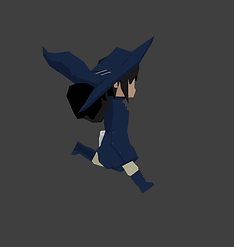
The effects of Automatic Weights
One issue encountered during this process was clipping through the legs and the robe due to the low vertex density in that area. This was resolved by increasing the vertex count with a loop cut (Blender Docs, 2026c) and manually adjusting weights so that each leg influenced only its respective side of the mesh.
Inverse Kinematics (IK) (Blender Docs, 2026d) was implemented to streamline animation. By controlling limbs through end bones, IK allows for more intuitive posing and reduces the complexity of animation multi-joint movement, improving both efficiency and consistency.


The Eliza Rig
For the demo, Eliza required a range of animations, including movement states (idle, walking, running) and combat actions. The animation process followed a standard workflow of blocking out key poses before refining motion through secondary passes. Tutorials such as those provided by Garage Farm (n.d) informed this approach of resulting in animation cycles that appear fluid and cohesive.
Walking - First Pass
Walking - Second Pass
Idle
Run
Swinging
Merlin
Merlin functions as a guide character, introducing the player to the world and its underlying systems. He is loosely inspired by the Microsoft Office Assistant, both in name and role, as well as the traditional mentor figure found in Arthurian legend. Within Galatea, he leads an organisation known as the ‘Install Wizards,’ who aim to combat the growing influence of Galatea, fighting computer virus themed enemies sourced directly from the AI. As such, his primary narrative role is to provide exposition, direction, and context during the preliminary stages of the game.
From a design perspective, Merlin fulfils the role of a diegetic tutorial system. Rather than presenting mechanics through abstract UI prompts information is delivered through character interaction, maintaining immersion within the game world. This aligns with the principles outlined in The Design of Everyday Things (Norman, 2013), where effective design reduces reliance on explicit instruction by embedding guidance within the object system itself. In this case, Merlin functions as an in-world ‘signifier,’ directing player behaviour through narrative interaction rather than external UI.
This initial concept for Merlin extended beyond that of a conventional mentor. He was also designed to either represent or be directly connected to the figure of Pygmalion and the creation of Galatea. As a result, it was important that his visual design subtly communicated the possibility that he is withholding information from the player. This introduces an element of uncertainty, encouraging the players to question his intentions despite his role as a guide.
This is reflected through deliberate visual constraints. Unlike other characters, whose hands are free-floating, Merlin’s arms are consistently positioned behind his back. This closed posture reduces visible body language, highlighting the uncertainty of his motivations. Additionally, his eyes are obscured beneath the brim of his hat, limiting direct emotional readability and preventing the player from fully interpreting his expressions.
However, restricting key expressive features introduces a design challenge. To compensate for the eyes and hands, exaggerated facial features such as large bushy eyebrows are used as the primary means of emotional communication. Their movement allows for a range of expressions, including surprise, curiosity, and concern, ensuring that the character remains readable and engaging despite the intentional concealment of other features.
Visually, Merlin draws heavily from established wizard iconography, including a pointed hat, long robes, staff, and star motifs. The use of familiar archetypes is supported by Norman (2013), as he posits that successful design relies on making knowledge available in the world, allowing the player to quickly infer the wizard’s role without explicit explanation. In early gameplay this reduces cognitive load by enabling players to quickly understand that he is a source of knowledge and guidance.
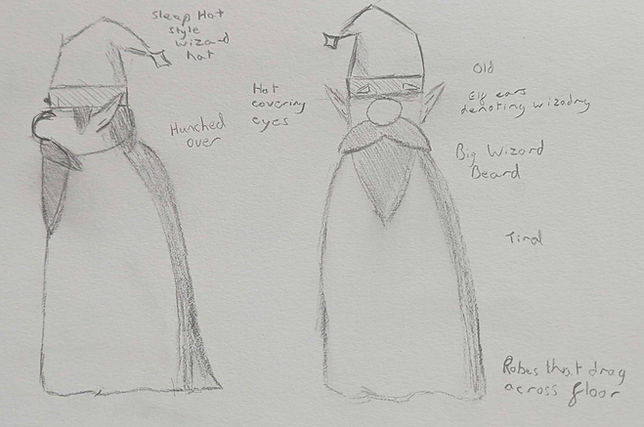
Merlin Concept Sketch
Modelling & Texturing
In contrast to Eliza, Merlin’s design is intentionally simplified, with fewer moving components. This reflects his role as a static character within the game. Mechanically, Merlin is most often encountered within fixed locations, such as his shop, and only moves in limited circumstances. When he does move, his animations are slow and deliberate, reinforcing his role as a composed and controlled figure. As a result, a less complex model was appropriate.
Merlin’s staff was created using a Bezier curve (Blender Docs, 2026b), following a similar process to Eliza’s sword. This approach allowed for precise control over curvature and thickness. Allowing for quick changes and experimentation before committing to a static form. The staff also acts as a visual signifier of his role, him holding a walking aid rather than a traditional weapon signposts his role as a guide and observer as well as reinforcing the wizard archetype while also contributing to his overall silhouette.
A deliberate decision was made to depict Merlin as a black character. This choice reflects an awareness of representation within character design and aligns with the principles outlined in Sustainable Development Goal 10.2 (2012), which promotes social inclusion regardless of race. Importantly, this decision was not framed as an exceptional trait within the character design, but rather as a normalised aspect of his identity. This supports the broader aim of integrating diverse representation without reducing characters to caricatures.
Texturing of the hair was achieved through using the custom brush set (Gardella, n.d). By introducing noise along the boundaries of the hair and reducing brush strength, a softer transition from hair to skin. This technique avoids harsh, artificial edges and better reflects how hair would naturally thin out. The result being consistent with the overall project’s stylised, hand-painted textures.


Merlin

Merlin Texture
Rigging & Animation
In contrast to more complex humanoid characters, Merlin’s rig was intentionally simplified due to the absence of fully articulated limbs. The design does not require independent arm or leg movement, allowing the rig to be reduced to a minimal skeletal structure consisting primarily of the spine, head hat, facial hair, and staff. This streamlined approach improves efficiency by reducing setup time and minimising potential deformation issues, while remaining sufficient for the character’s intended functionality.
Despite its simplicity, the rig still supports secondary motion through additional bones, controlling elements such as beard, hat, and staff. These components are important in maintaining a sense of life within the character, compensating for the lack of large-scale movement. Subtle motion in these areas reinforce personality and prevent the character from appearing static or unresponsive during interaction.
At the current stage of development, Merlin has not been implemented within the playable demo and therefore does not yet utilise a complete animation set. However, this intended movement design has been considered in advance. Unlike Eliza whose movement is responsive and player-driven, Merlin’s motion is designed to be slow and deliberate, reinforcing his composed and controlled demeanour.
The proposed walk cycle reflects this intention. Movement would be achieved through a combination of subtle forward tilting and moving the whole rig in the direction of movement. Then the rig would slide back a set distance, slower than the initial forward jolt. This would create the illusion of walking within the Unity engine. This is due to how, relative to an object with constant motion, an object moving in short bursts would appear to oscillate back and forth.

Merlin's Rig
Rat
Following the project’s overarching theme of presenting fantasy through a science-fiction lens, enemy design draws heavily from concepts found within cyber security. Remote Access Trojans (RATs) are a form of malware that provides unauthorised remote control over an infected system (Fortinet, n.d). This enemy type transforms that concept into a creature design that combines elements from a computer mouse with the physical form of a biological rodent.
The core design intention was to reflect the behaviour of a RAT within gameplay. Trojans operate covertly before exerting control, this enemy is designed to appear passive before engaging in combat. Early concepts explored the hybridisation between the organic and the technological, resulting in a creature that retains key rodent characteristics, such as hind-legs and ears, while incorporating technological features such as a USB cable tail used as its primary mode of attacking the player. Mechanically, this tail functions as a direct translation of the RAT concept. When the enemy attacks the player, it uses the tail in a scorpion-like motion to ‘inject’ damage.

Rat Concept Sketches
Modelling & Texturing
Following the previously established workflow, the design process started with a rough block out of key features. This allowed for quick iteration before moving onto the texturing phase. The visual design of the Rat incorporates an oversized head requiring that locomotion requires the hind-legs to drag the head around like a computer mouse. This is paired with the character design principle of characters lacking arms to create an effect of a biology fused with technology.


The ears feature spiral patterns that resemble pseudo-eyes, a visual technique observed in real world animals as a deterrent against predators. This adds a layer of biological realism while also increasing visual interest. From a technical standpoint, the UVs for the ears were separated to allow for cleaner circular shapes, avoiding the distortion and jagged edges that would result from a limited texture resolution.
Surface retailing along the back draws from the texture of a computer mouse, with spot patterns resembling grip materials. This reinforces the hybrid nature of the creature, blending organic and manufactured aesthetics in a cohesive way.
Facial design underwent iteration throughout development. An earlier version of the model lacked eyes, which reduced readability as a creature rather than an object. The later addition of eyes increased zoomorphic qualities, making it more immediately recognisable as a creature and improving its ability to communicate intent to the player.
A key feature of the design is the USB tail. Each side of the connector is textured differently, allowing it to resemble either a passive or aggressive ‘face’ depending on the angle it is viewed. This duality reflects the deceptive nature of Trojan viruses, often appearing as harmless programs before enacting their malicious intent. Reiterating themes of providing information visually without explicit explanation (Norman, 2013).


Rat

Rat Texture
Rigging & Animation
The Rat’s rig controls the head, ears, legs, and tail, with inverse kinematics (Blender Docs, 2026d) applied to the legs and tail to allow for more controlled and flexible animation. Given the small scale of the character and its role within the demo, Blender’s automatic weight assignment (Blender Docs, 2026) provided sufficient weights, requiring minimal manual correction.
The animation set consists of three primary states: idle, movement, and attack.
The idle animation is the creature's baseline state. The tail is held in a near-vertical position, slowly swaying to display the passive ‘face’ on the USB connector. Occasional ear twitching introduces a secondary motion, reinforcing the impression of a living organism, despite its technological components, as well as drawing the player’s attention to a potential danger. This combination of motion helps maintain visual interest while signalling that the enemy is not yet aggressive.
Upon detecting the player, the creature transitions into the walk cycle. The tail lowers into a scorpion-like position, immediately signalling threat. Simultaneously, the legs begin to move, a wide stance is used to emphasise the weight of the oversized head, creating a sense of forward momentum. The tail continues to sway in rhythm with movement, synergising both parts into one animation that feels whole.
The attack animation is designed to be both readable and impactful. The tail strikes forward in a sharp, decisive motion, while the head retracts slightly to emphasise the force of the action. In tandem, the two motions enhance the perceived impact of the attack.
There is an issue in-engine where the transition between the idle and other states causes the tail to snap in position rather than translate there naturally. The solution to this would be to incorporate an extra animation state when transitioning from idle where the tail can properly adjust itself in a natural way. To not interfere with other aspects of the animation, animation masks (Unity Docs, 2026) should be utilized to separate the leg and tail motions.
Idle
Walk
Attack
Skeleton
In contrast to the other enemy types within Galatea, the skeleton is not directly derived from real-world computer science concepts. Instead, it draws from established fantasy tropes and widely recognised danger iconography, particularly the use of skulls to signify threat. While this diverges from the dominant design language of virus-based enemies, the inclusion of the skeleton serves as a conventional enemy archetype that can be universally read as an enemy.
One potential thematic link could be the idea of a ‘skeleton code,’ a rudimentary or partially completed program. In this context, the skeleton enemy can be interpreted as a basic entity, reflected in its simple behaviour and visual construction. While this connection is more abstract than other enemy designs, it provides a thematic bridge between the traditional fantasy imagery and the overarching cyberpunk aesthetic.
From a design perspective, the skeleton functions as a basic enemy type. Its simplicity is intended to allow players to quickly intuit its behaviour, making it effective in early encounters where clarity is more important than challenge. This aligns with wider game design practices where introductory enemies are used to teach core mechanics without overwhelming the player.
This approach also supports potential progression in enemy complexity as the player advances through the game. While the skeleton represents a rudimentary program, its simplicity establishes a baseline from which more advanced, self-defined humanoid enemies can be introduced. As the player descends into deeper layers of the internet, enemies can be designed to reflect increasingly sophisticated code, adapting to the growing threat of Eliza and the Install Wizards.
Visually, the skeleton borrows elements from Eliza’s design, particularly the use of free-floating components. However, unlike Eliza, whose floating hands are used to represent interacting with the internet using a cursor, the skeleton’s entire body is segmented and disconnected. The absence of visible joints or connective tissue creates a sense of instability and fragility, reinforcing its role as a weaker enemy.
Modelling & Texturing
Visually, the skeleton borrows elements from Eliza’s design, particularly the use of free-floating components. However, unlike Eliza, whose floating hands are used to represent interacting with the internet using a cursor, the skeleton’s entire body is segmented and disconnected. The absence of visible joints or connective tissue creates a sense of instability and fragility, reinforcing its role as a weaker enemy.
In total, the model is constructed from six separate objects: a head, torso, two hands, and two feet. This modular approach simplifies both rigging and animation while reinforcing the visual concept of a disjointed body.
Despite the overall simplicity of the model, minute details were introduced to enhance visual interest and readability. Additional geometry was added around the eye sockets to create subtle depth, allowing the simple red pupils to appear more dynamic as the viewing angle changes. This gives the impression that the skeleton is observing the player despite the lack of direct eye animation.
Further design elements were incorporated to reinforce its hostile nature. Spikes positioned at the back of the head introduce sharper shapes to the silhouette, a common visual language used to communicate danger. This ensures that the character is clearly identifiable as an enemy.
Texturing is deliberately minimal, relying on contrast between light and dark values to suggest form and depth. The texture supports the stylised aesthetic of the project while maintaining clarity.


Skeleton

Rat Texture
Rigging & Animation
The rigging process of the skeleton mirrors that of Eliza, adapted to accommodate its segmented structure. Each individual component is assigned its own bone, allowing for independent movement with zero deformation. This approach is effective for a rigid, floating 3D model.
As with other enemies, the animation set consists of three primary states: idle, locomotion, and attack. However, the skeleton’s animations are designed to emphasise instability and lack of coordination, reinforcing its identity as a weaker, less refined entity.
The idle animation establishes this tone through loose, rhythmic motion. Each movement sends ripples throughout the body. Occasional sharp twitches introduce unpredictability, drawing inspiration from erratic character animation such as Skull Kid in The Legend of Zelda: Majora’s Mask (2000). This creates a sense of unease while maintaining visual interest.
The walk cycle is intentionally clumsy and exaggerated. Rather than smooth, coordinated movement, each step resembles a stomp that sends reverberations through the entire body. This lack of refinement communicates both weight and instability, distinguishing the skeleton from more controlled or deliberate characters.
The attack animation continues this theme. The skeleton mimics Eliza’s sword swing in a more uncontrolled manner, its head being thrown backward due to the sudden motion. This suggests that the skeleton lacks the precision or intent present in more advanced characters. The result is an attack that is readable and unrefined, aligning with its role as a basic enemy.
Idle
Walk
Pierre Clipp
Pierre Clipp was designed as the primary boss encounter for the opening dungeon, fulfilling both a narrative and mechanical role. Inspired by Clippy, the Microsoft Office Assistant, the character draws on the cultural perception of early AI assistance as intrusive and often unhelpful. This provides a foundation for both his personality and narrative motivation.
Within the game’s story. Pierre is introduced early as a minor character who provides brief exposition regarding Galatea. However, his underlying motivation is driven by his own inadequacy; much like his real-world inspiration, he is defined by his failure to fulfil his intended purpose. As a result, he seeks out Galatea in the hope that she can grant him the power to become more capable. This aligns him with the other boss characters, each of whom pursues Galatea for personal gain, reinforcing a consistent narrative structure.
At the culmination of the dungeon, Pierre reappears as a boss, having acquired a fragment of software capable of defeating Galatea. This transformation manifests visually as an exaggerated, muscular version of himself, with a body constructed from coiled metal. The contrast between his original paper clip form and this hyperbolic ‘improved’ version reinforces the absurdity of his ambition and his role as a trickster figure.
Following his defeat, Pierre serves multiple roles. In addition to offering contextual information or humorous dialogue within menus, he also transforms into the player’s primary weapon. A sword wielded by Eliza, growing in strength and usefulness as the player progresses. This dual functionality reinforces his narrative arc, transitioning from an ineffective assistant into a meaningful contributor to gameplay.
From a narrative perspective, this character embodies the trickster archetype, as described in Videogame Storytelling (Skolnick, 2014). His exaggerated design, transformations provide comic-relief to balance the serious themes of identity and control present in the wider narrative. At the same time, the character reflects the broader themes of artificial constructs striving for purpose, mirroring Galatea herself.

Concept Sketches of Pierre Clipp
Modelling & Texturing
This is the only current character that requires two distinct models to support his transformation: a base form and a boss form.
The base model was created using a Bezier curve (Blender Docs, 2026b) to achieve the smooth, continuous shape of a paperclip. This method allowed for precise control over curvature while maintaining a clean efficient topology. Facial features were added as separate meshes. To differentiate the design from the original Clippy, additional features such as a nose and moustache were introduced, giving the character a more distinct identity while retaining recognisability.
The boss form expands on this foundation by introducing a stylised muscular body constructed from coiled metal. This design draws from exaggerated bodybuilding physiques, creating a humorous contrast between the flimsy, minimal paperclip head, and the oversized muscular body. The contrast reinforces the character’s narrative theme of overcompensation and self-perceived inadequacy.

Pierre's Base Model


Pierre's Boss Model

Pierre Clipp Texture
Rigging & Animation
Although Pierre is not currently implemented within the demo, the character was fully rigged in preparation of future integration. This ensures that the future workload is reduced, and animations can be added quickly and efficiently at a later stage.
Planned animations will reflect the character’s personality. The base form will move erratically with little regard to physics to emphasise the comedic aspect of the character. In contrast, the boss form will be slow and clumsy to reflect the change in proportions.

Pierre Clipp Rig
Final Word
This project explored the design and implementation of character-driven assets within Galatea. The characters were designed to reflect core themes of the game such as identity, artificial consciousness, and control. Through the development of five distinct characters, the project aimed to demonstrate and develop technical proficiency in 3D asset creation and explore the use of character design as a tool to enhance narrative and gameplay.
A key outcome of the project was the successful fusion of character design and mechanical function. Each character was developed with a clear visual identity, and an understanding of how that identity would translate into gameplay. The protagonist, Eliza, was designed to be visually readable within complex scenes, reinforcing her role as the player's primary point of focus. Characters such as Merlin and Piere Clipp demonstrate how design can be used to guide, and support the player, embedding functionality into their narrative roles. Enemy Characters, including the Rat and Skeleton, further illustrate how visual and behavioural design can communicate intent and difficulty to the player.
The project also highlighted a strong understanding of the development pipeline, prioritising the development of certain characters over others to ensure that deadlines are met effectively and allowing time for further refinement.
A central theme underpinning the project was the exploration of identity. This is reflected across all the characters, from Eliza not being a self-insert character for the player to project their own experiences onto, to the skeletons who are defined by their lack of identity and their potential to develop and evolve as the story progresses.
In concussion, the project demonstrates a comprehensive understanding of character design within a game development context, combining creative direction with technical execution. In addition, there is a clear framework for the project’s future direction, particularly in expanding the cast of characters as well as implementing animation systems for a completed playable demo.
References
Blender Docs (2026) Armature Deform Parent - Blender 5.1 Manual. Available at: https://docs.blender.org/manual/en/latest/animation/armatures/skinning/parenting.html [Accessed 7 May 2026].
Blender Docs (2026a) Texture Paint - Blender 5.1 Manual. Available at:
https://docs.blender.org/manual/en/latest/sculpt_paint/texture_paint/index.html [Accessed 7 May 2026].
Blender Docs (2026b) Curve Primitives - Blender 5.1 Manual.. Available at:
https://docs.blender.org/manual/en/latest/modeling/curves/primitives.html#bezier-curve [Accessed 7 May 2026].
Blender Docs (2026c) Loop Cut - Blender 5.1 Manual. Available at:
https://docs.blender.org/manual/en/latest/modeling/meshes/tools/loop.html [Accessed 7 May 2026].
Blender Docs (2026d) Inverse Kinematics - Blender 5.1 Manual. Available at: https://docs.blender.org/manual/en/latest/animation/armatures/posing/bone_constraints/inverse_kinematics/introduction.html [Accessed 7 May 2026].
Deoiunti, I. Saukko, P. Natale, S. (2022) Ideal technologies, ideal women: AI and gender imaginaries in Redditors’ discussions on the Replika bot girlfriend. Media, Culture & Society. 45, (4). Available at: https://doi.org/10.1177/01634437221119021 [Accessed 7 May 2026].
Fortinet (n.d) Remote Access Trojan (RAT). Available at: https://www.fortinet.com/uk/resources/cyberglossary/remote-access-trojan#:~:text=According%20to%20the%20Remote%20Access,the%20owner%27s%20consent%20or%20knowledge [Accessed 7 May 2026].
Garage Farm (n.d) Walk Cycle: Easy Steps to Animate Walking Animation for Beginners. Available at: https://garagefarm.net/blog/walk-cycle-easy-steps-to-animate-walking-animation-for-beginners#section-4 [Accessed 7 May 2026].
Gardella, W. (n.d) Microghost Painterly Blender Brushes. Gumroad. Available at: https://microghost.gumroad.com/l/qzfdc?layout=profile&recommended_by=library [Accessed 7 May 2026].
Norman, D. (2013) The Design of Everyday Things. 2nd edn. United States: Basic Books.
Ovid (1480 [8]) Metamorphoses. Book 10
Shaw, G (1912) Pygmalion.
Skolnick, E. (2014) Video Game Storytelling. United States: Watson-Guptill Publications.
The Global Goals (2012) Goal 10: Reduced Inequalities. Available at: https://globalgoals.org/goals/10-reduced-inequalities/ [Accessed 7 May 2026].
The Legend of Zelda: A Link Between Worlds (2013) 3DS [Videogame]. Japan: Nintendo.
The Legend of Zelda: Majora’s Mask (2000) N64 [Videogame]. Japan: Nintendo.
The Models Resource (2026) The Models Resource. Available at: https://models.spriters-resource.com/ [Accessed 7 May 2026].
Undertale (2015) PC [Videogame].
Unity Docs (2026) Unity Avatar Mask Window reference. Available at:
https://docs.unity3d.com/6000.4/Documentation/Manual/class-AvatarMask.html [Accessed 7 May 2026].
Bibliography
Norman, D. (2013) The Design of Everyday Things. 2nd edn. United States: Basic Books.
Skolnick, E. (2014) Video Game Storytelling. United States: Watson-Guptill Publications.
Gibson, W. (1984) Neuromancer. London: Orion Publishing Group
Ellison, H. (1967) I have no Mouth and I must Scream. United States: Pyramid Books