DM3108 - Negotiated Game Placement:

Word Count: 5010
15/01/2026
Score: 67/100
Project Brief & Role
'Slackers is a chaotic multiplayer game where the players assume the role of undercover aliens infiltrating various human workplaces via a fake temp agency. Their objective? To destabilize the workforce sector through ridiculous inefficient sabotage.’
As 3rd Years, we were tasked with securing an industry-relevant placement to fulfil the work experience component of the course. This placement required a minimum of 80 hours logged on InPlace to be recognised by the university. Initially I had successfully arranged a placement as an Art Intern with the independent game studio AppleBomb Games. This opportunity aligned closely with career goals as it provided direct exposure to professional production pipelines and proper version control and a credit on a game by the time of graduation. However, they did not possess the proper insurance required by the university to log the experience on InPlace. As a result a placement could not be formally approved.
While this was a setback, not all hope was lost. The alternate opportunity of a client project was presented, equivalent to a placement in terms of University credits. This client project was Slackers, provided by RaRa Games. Despite being primarily structured as a group project for second–year students, the option was to participate independently with a specific area of development. This provided a unique level of autonomy compared to a typical internship, allowing for a self determined scope and independent creative decisions. Despite not resulting in a game credit, this still provides a valuable experience and opportunity to advance the skillset into unfamiliar areas.
For this project, it was decided that the production of a modular set of 3D props would be developed that could be used to construct an office-based environment. This decision was informed by a desire to develop skills regarding 3D modelling inanimate objects as well as improve texturing and optimisation. This desire originated from a previous focus on a character based skillset (modelling, rigging and skinning), this caused prop-focused design ability to atrophy slightly. From a production standpoint, the props are highly reusable and applicable to many modern environments and different game genres.
Additionally, a multitude of props contributes to the level of chaos possible for the player to create. In a physics based multiplayer experience, the ability to grab, move and throw objects allows chaos to emerge naturally, rather than being in scripted events. The greater the variety of props, the more opportunities for the player to experiment with their surroundings, leading to more unpredictable and humorous outcomes. Reinforcing the game’s identity as a system-driven experience rather than a linear one. Additionally, certain props can have specific use cases, resulting in unique interactions depending on the object. The more chaotic the interaction the more points – or whatever constitutes player progression – are rewarded.
Client communication was conducted through a combination of both in-person meetings and online via Discord and email. The majority of communication regarding the project was during the preproduction stage. This included discussions surrounding deliverables, stylistic direction, and overall scope. Due to the independent nature of the project, software dedicated to version control such as Git or P4 were unnecessary as assets were not required to be shared until the final package of deliverables. Previous versions of the project were stored and backed-up locally, this was paired with incremental saves that would prevent losses from permanent changes as an older backup would be available
This report will provide an overview of the different stages of development. Beginning with preproduction in which the creative vision, art-style, time management methodology, and deliverables were decided. Then production where assets were created, reasoning behind creative decisions, information on polycount and LODs, and the construction of an example scene.
Sustainable Development
An increasingly important point of interest within the current game development industry is the use of generative AI. Whilst it can be a useful tool in streamlining development through rapid prototyping and content generation, it has an incredibly adverse effect on the planet (Zewe, 2025). Training and running AI models requires a significant amount of energy, contributing to carbon emissions and consuming resources far beyond what our planet can provide.
This issue closely aligns closely to Sustainable Development Goal 12: Responsible Consumption and Production (The Global Goals, 2012), which advocates for the efficient use of resources and the reduction of waste. Although SDG 12 is mainly in relation to physical manufacturing, its principles are also applicable to digital production. In the context of game development, excessive computation, redundant geometry and inefficient workflows contribute to unnecessary energy use.
In response to these concerns, a deliberate decision was made to prohibit the use of AI tools at any stage of this project. This policy also ensures that all assets were created manually, prioritising intentional design and making all products the sole work of the designer. Additionally a strong emphasis on optimised and effective topology and proper utilization of LODs was prioritised to combat computational concerns and improve the player experience by ensuring smoother performance across a range of potential platforms.
01 Preproduction
Creative Vision
The first stage of preproduction was focused on establishing a clear and flexible creative vision for the project. This involved identifying a workspace environment that would be immediately recognisable to the players while offering a broad range of interactive and comedic possibilities. Potential settings ranged from zoos, to funeral homes, to theaters. These were ultimately discarded in favour of an office environment. Offices are one of the most universally understood workplaces, making it ideal to be an initial level of the game and holds great potential for environmental storytelling and various alien-based hijinks.
In contrast, an alternative environment such as a Zoo would have lots of opportunities for large-scale shenanigans, such as leaving the door to the lion enclosure open, increasing the heat to the penguin exhibit (potentially turning the enclosure into a beach for the birds to sunbathe), releasing a Jurassic Park style dinosaur to torment the guests. These sort of interactions better suit a late stage level, compared to the simplicity of an office.
From a production perspective, offices also contain a dense variety of equipment, furniture, and stationary, making them well suited to a prop-focused 3D modeling project. This abundance allows for boundless opportunities when determining what to produce. Additionally, an office environment is usually a dull boring place, this will contrast greatly with the player driven chaos. However, there is a possibility that an office would be too boring. The uneventful nature of a bland environment such as an office could negatively impact the player experience if it is not paired with fun and engaging mechanics.
Due to the nature of the project and the freedom it provides, especially compared to the original internship that had a rigid art-style and direction, it was decided that production should follow a similar design philosophy to designing commercial 3D asset packs. This is due to how an artist does not know the developer’s specific technical requirements or gameplay style in advance. As a result a careful balance between creativity and generality was required. Each asset needed enough personality to contribute to the game’s chaotic tone, whilst remaining neutral and flexible enough to apply to multiple scenarios.
Art Style
The game’s art style would inform all of the design decisions. This is why a specific creative vision had to be determined in preproduction before modelling started. The game's premise leans towards a stylised, slightly cartoony aesthetic compared to strict realism. Stylisation also allows for lower overall polycounts without appearing unfinished, supporting goals regarding performance optimisation and responsible digital production. In terms of stylisation, two games stand out that this project drew inspiration from.
First was Human Fall Flat (2016), a puzzle-platform game that has an emphasis on chaotic physics and strong interactions with environments. This game opted for simple, flat textures that are usually a single colour. Characters also move in strange, ragdoll-like movements reminiscent of an alien pretending to be human.
Secondly was Octodad: Dadliest Catch (2014), an adventure game about destruction and deception. In this game an octopus masquerading as a man goes around town completing tasks and causing chaos, all without raising the suspicions of his human family. This obviously shares a theme of deception with slackers, with a more detailed art direction than Human Fall Flat.
Deliverables
During preproduction, a comprehensive list of 34 potential props were initially compiled. This longlist allowed for broad ideation without immediate constraint, from this, a shortlist of 20 Deliverables was finished:
-
Cubicles
-
Computer monitor
-
Computer Tower
-
Keyboard
-
Desk
-
Chair
-
Filing Cabinet
-
Mug
-
Lamp
-
Box
-
Bin
-
Pencil Pot
-
Phone
-
Posters
-
Potted Plants
-
Cactus
-
Stapler
-
Water cooler
-
Whiteboard
-
Paper Ball
The reduction from 34 to 20 assets was a deliberate decision to limit scope. In game development there is often the issue of scope creep (Sánchez, 2025), by clearly defining the project scope and setting key development milestones to prevent workload increasing beyond what was possible ensuring deadlines were met. Each selected prop met a certain criteria: recognisability within an office environment, potential for environmental storytelling and humour, and suitability for reuse. This filtering process ensured that time was only investing in making props that contributed to the final scene
Scene
Although the project primarily focused on individual assets that could be used in production of a vertical slice of a game experience. It was important to consider and represent how these props can cohesively exist within an office scene. This helped ensure consistency between models.
Documentation
The handover documentation serves as a record of the project’s key details, including objectives, deliverables and timelines. The Documentation includes a project breakdown, what was produced, information regarding poly count and file types, information about textures, and contact details for further inquiries. A good handover document prioritises clear concise language that is easy to understand. The document is paired with the FBX assets and sent over to the client on the project's completion.
Time Management
Time management was approached experimentally to try and derive insights of how different development styles would impact how assets were produced. This was possible largely due to the increased level of creative control. Unlike a formal production environment with an established art director and frequent sign-offs, this project allowed for greater autonomy. As a result, modelling and texturing were separated into two distinct phases rather than completing one asset at a time.
All models were first blocked out and finalised before moving into a dedicated texturing phase. This method was chosen to test the hypothesis of whether batching tasks would be more efficient than a linear, asset-by-asset workflow due to preventing the cognitive impact of shifting between different tasks. In addition, a set number of clearly defined deliverables was particularly suitable for this test.
This contrasts with the original placement’s workflow, where small batches of assets were requested, made, reviewed, revised, and then textured. This slowed down production due to a time zone difference. The reduction of feedback, bottlenecks and context switching should improve productivity and workflow and reduce wasted time.
Displayed below is a Gantt chart to visualise the two production phases within the confines of the 80 hour placement.

02 Production
This section outlines the production process behind the office equipment assets created for a game environment centred on alien sabotage. The aim was to contrast a recognisable and mundane corporate setting with the bizarre premise of extra-terrestrial interference. Offices are generally visually cohesive environments by nature, making them an effective backdrop for chaos-driven games.
Each asset was designed with three core goals in mind: visual clarity, technical efficiency, and modular reuse. This production policy aligns strongly with Sustainable Development Goal 12 (The Global Goals, 2012), particularly due to its application to design pipelines, optimisation and long-term sustainability within game development.
In digital art and game production, sustainability is not concerned with physical waste, but is maintained through efficient workflows, asset reuse, and performance-aware design. Excess geometry and texture resolution adds to computational cost, energy use, and development time.
Level Of Detail Foreword
In game development, Level of Detail (LODs) refers to the complexity of a 3D model compared to the distance it is away from the camera. LOD techniques increase the efficiency of rendering by decreasing the workload on the GPU. LODs were planned to be included in the deliverables from the earliest stages of production, with multiple major assets including at least one LOD. Most game engines have native compatibility with LODs, swapping between models based on camera distance. This ensures consistent performance in scenes with a heavy use of props.
From an SDG 12 standpoint, LODs ensure responsible resource allocation within a real-time environment. The reduced GPU workload, energy consumption, and thermal strain all align with the responsible consumption of resources.
There was a debate on whether to utilize LODs or not due to the majority of assets already being low-poly and how if the game was designed with a fixed top-down camera angle then they would be useless due to how the models could be culled offscreen. However, due to the benefits of practicing the production of LODs and the greater freedom they would provide to game developers in terms of project direction and optimisation, it was decided they would be produced.
There are many cases of models without LODs. For example, the phone could have benefited from having a similar treatment to the keyboards, having the buttons geometry be reduced and removing unnecessary edge loops.
Cubicle pannels
Cubicles are the building blocks of many office environments. They are designed to maximise floor efficiency and minimise human interaction. Limiting distractions by shielding employees from distraction, sunlight, and the dangerous possibility of making lasting bonds with co-workers. Surprisingly, studies have shown that this can negatively impact mood and productivity (Fastcubes, 2022).
A core design pillar of Slackers is the player balancing the chaos they cause and the suspicions of surrounding humans. The addition of cubicles, whilst this is not ideal for a real life office worker, provide a perfect cover to conceal the misdeeds of the alien saboteurs.
From a production standpoint, the cubicle panels are designed to be modular, repeatable assets. This provides a greater freedom to level designers, allowing them to construct the shapes they need without bloating file size with multiple panel sizes and shapes. This modularity directly supports SDG 12 (The Global Goals, 2012) by reducing redundant asset creation and . To further the freedom of designers, three colour variations were created. These were created through procedural material inputs rather than unique texture maps.


The panels also have three levels of detail, slowly removing depth in geometry as the player moves further away.
Computer Monitor, Tower and Keyboard
The monitor, the tower and the keyboard. While it sounds like a children’s novel, it is the first group of models that were produced. This was due to the relevance in modern office environments. Despite this, it was a deliberate decision to produce a more retro setup as it would add to the stylistic atmosphere of the game. A boxy monitor would be more effective in physics interactions, allowing the player to throw around and recognise it from a distance. This retro aesthetic either means that Slackers is set in the distant past of the late 90s early 00s, or that management doesn’t want to invest in an upgrade. Who needs aliens sabotaging your business when you still have dial-up internet?

Monitor
First was the monitor. This was far from being the first monitor I have 3D modelled, with Code&Canvas’ – The 2025 end of year exhibition – mascot being based on the iMac G3. In this instance, the model and colours were based on a generalised idea of 90s desktop computers rather than a specific real - world model. An emphasis was placed on the boxy design and hard edges, as well as the off-white, slightly discoloured plastic that implies its age. The monitor also features an oversized On button paired with a light that – through an emission material – indicates the power status of the machine.
The monitor includes four interchangeable 28x22 screen textures:
-
The basic blank ‘off screen’ – The default idle state of any computer.
-
The blue screen of Death – A cultural necessity, particularly suited for alien interference.
-
The classic, and more importantly copyright-free, Linesweeper on the LintRolls98 operating system.
-
A Generic Spreadsheet – Visually implies that this business has productive employees and looming deadlines.

These textures are deliberately Low resolution to match the retro aesthetic and minimise memory usage. When producing a pixel art texture it is important to change the interpolation from closest to linear. This will ensure crisp, sharp edges to the pixels and remove any blurring.
Computer Tower
The horizontal computer tower mirrors the monitor’s design language, reinforcing visual unity. This model is an abstraction of real-world pc cases, featuring oversized vent panels and a simplified disc reader. This reduces polygon counts and contributes to a cartoony art-style.


Keyboard
Three keyboard variants were created to support different gameplay needs:
-
Abstracted Keyboard – Reduces key count, suitable for mid-distance viewing.
-
Realistic Keyboard – Featuring a full key layout and numpad, suitable for close interaction such as in a VR experience
-
Oversized ‘DELETE’ Key Keyboard – A prop that communicates an action.
The oversized delete key functions as environmental storytelling and player guidance. In The Design of Everyday Things, Norman (2013) communicates the importance of communication in design. The visual language of the big red button with a bold, capitalised and underlined ‘DELETE’ communicates a destructive action. Whether its is by stepping by the button and clicking an interact key, or by the player character physically colliding with the button, the player should expect an Interaction. This could range from the monitor blue-screening, or the sounds of a distant explosion.
LOD Breakdown
The monitor decreased geometry by making the screen flush with the case and the back box has reduced edge, Additionally the stand for them monitor was removed due to not being very visible
Tower: 62 Faces to 42
The tower decreases geometry by making all parts such as the vent panels and disc reader completely flush
Keyboards
Complex: 608 to107
Abstract: 288 to 53
Delete: 11 to 7
The Keyboards generally reduce geometry by removing the sides of the keys, dividing the overall geometry by ~5.


Chair
The office chair is a standard five-wheel swivel chair with fabric cushions. It was designed to be instantly recognisable while remaining reusable in each cubicle.
The wheels were constructed using an array modifier (Blender, 2026d) applied to a single wheel mesh, rotated at 72-degree intervals via an empty object. This ensures exact spacing between the wheels without the need of manually placing them. The leg was then constructed from the wheels inwards to the centre cylinder. The cushions were made from squashed, subdivided cubes, shaped into a curve. The backrest is connected through a curve that was converted into a mesh to ensure a clean and consistent curvature.
LODs: 415 to 295 Faces
Desk
In tandem with the office chair, the office desk was a simple black table with two legs and a set of functional drawers. Simplicity was intentional: desks appear frequently, and excessive detail would add unnecessary computation.
Drawers are separate objects to the desk, this allows them to be opened, removed and tossed about by the aliens.
Geometry 155 faces

Filing Cabinet
The filing cabinets work similarly to the functional drawers on the desk. The cabinet stands at 3 drawers tall and is a traditional ‘metal grey’. Handles, seams and drawer gaps create readability at a distance.
Geometry: 138 Faces
Mugs
Six mug variations were created, consisting of three unique textures and two liquid fill levels for each. Mugas are small props but contribute significantly to environmental storytelling.
-
Plain White Mug - Classic, unremarkable
-
Stainted ‘#1’ Mug - Suggests corporate ambition and caffeine dependency
Television Reference - Features a green alien on the base, referencing The IT Crowd (2006). The mug with Moss’ face on it to indicate his ownership is shown being used by multiple other people. Who owns this mug? Probably someone from the ET department.


Liquid levels were implemented as simple alteration in the internal mesh rather than a fluid simulation. Depending on the style of the game, there are many ways to adapt this into pouring coffee or whatever the developer needs.
Geometry: 78 Faces
Lamp
The desk lamp features a gooseneck design, such used for adjusting its position. The bulb is a subdivided cube with an emissive material, paired with a point light for functionality.
Geometry: 316 Faces

Box
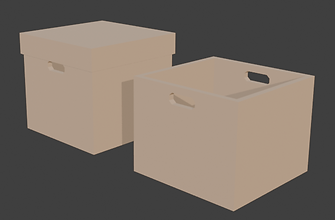
The cardboard box references the ‘Cardboard Box of Unemployment’ trope common in TV office narratives. The box is intentionally a plain brown, allowing it to be used modularly on desks shelves and wherever they might fit. The lid is a separate mesh, allowing for it to be removed to contain objects longer than the box’s dimensions and fall off if a player throws it during chaotic gameplay.
LODs: 160 to 32 Faces

Bin and Paper Balls
Bin being a cylinder with a flared top, solidified to add thickness. The interior base was raised to suggest fullness without additional meshes. Adorning the top of the bin is a scaled paper ball to indicate its fullness. The paper balls were created through the process of subdividing a plane and randomising the vertices, forming a convincing crumpled shape with minimal cost.
The paper balls atop and surrounding the bin suggests use and neglect, reinforcing the environmental storytelling of an average office.
Geometry:
-
Bin 188 Faces
-
Paper Ball 25 Faces

Pencil Pot
The pencil pot is intentionally low detail, reflecting its minor importance in the scene. It consists of a hollow cylinder and two elongated squares representing a pen and pencil.
With more art direction from the client, the model could be adapted to be higher fidelity if it needed to be viewed closely, such as in a VR game.
Geometry: 76 Faces

Phone
The office phone is fundamental to corporate communication. It consists of the receiver and handset, with the receiver modeled using a mirror modifier (Blender, 2026c) on the geometry to maintain symmetry.
Buttons on the phone are separate meshes parented to the handset. Allowing for interaction on a close scale similar to the keyboard.
Geometry: 180 Faces
Poster
The poster recreates the classic ‘Hang in there’ image in pixel art form. This stylistic choice matches the monitor resolution and avoids high-resolution textures. The background was created through a cloud generation and the cat and text were made in Aseprite. A critical analysis of this art leaves a lot to be desired, however due to time restraints it was important to prioritise the production of higher value assets.
Pixel art posters require minimal memory and match the fidelity of other models, aligning visual consistency with performance sustainability.
The poster is just a flat plane, therefore no LODs were necessary.


Cactus
Another low-maintenance plant perfect for an office is the cactus (Mcintosh, 2025) . Represented as a small orb-like plant with a single pink flower blooming on its top. Its size compared to the snake plant makes it ideal for desks and shelves.
LODs: 189 to 54 Faces
Potted Plant
The potted plant is based on a Snake Plant, a low maintenance plant common in offices that wish to add a little greenery to the workspace (Mcintosh, 2025).
It was created by an array (Blender, 2026d) of curves that shrink to a point at the top, this array was offset by an empty rotated and scaled down to create variation in size and position. This was done twice to create variations in depth between two rings of leaves. Then the curves were converted to meshes and then adjusted by hand to reduce any imperfections.
LODs were created by un-subdividing the geometry through a decimate modifier (Blender, 2026a) to reduce the poly-count from 464 to 222 faces.
Stapler
If anything can truly be called an office staple, it is the stapler. The model is simple and iconic, designed to be readable at a glance. Two variations in colour were created, one black and the other red.
Depending on gameplay needs, this model could be adapted from a prop into a potential interactive object. Potentially being equipped and used to shoot staples at unexpecting employees.
Geometry: 56 Faces


Water cooler
The water cooler serves as a social hub within the office. While being a hostile enemy in some games, here it exists only as a dispensary of water. The blue water jug is placed on-top of a white tower-like cylinder with a cube cut out with a boolean. In this divot are two spigots pouring either hot or cold water depending on the tap’s colour.
The jug was designed to be viewed both in and out of the water cooler, allowing for more variation in props.
Geometry: 683 faces
Whiteboard
The whiteboard features a mix of messages written on a 114 x 78 texture. These messages feature: co-ordinates of Area 51 (a conspiracies hub of aliens), a graph, a motivational message, a game of naughts and crosses, and doodle of a buff alien. All drawn with 4 cardinal colours expected in a pack of Whiteboard pens: black, blue, red and green.
This reflects office culture and reinforces the game’s tone.
Geometry: 38 faces


Scene
Displayed here is an orbiting camera view of a potential scene constructed using the provided asset set. This scene functions as a proof-of-concept, demonstrating how the individual props and modular components can be combined to create a believable and readable environment. It also demonstrates the building-block nature of the asset pack and how it can be adapted to suit a variety of gameplay needs.

The layout consists of four cubicle areas arranged in a plus-shaped formation. This configuration was chosen to demonstrate the modularity of the cubicle panels and their ability to form enclosed work spaces. Two of the cubicles are decorated as an employee work space. They include variations in desks, chairs, computers, and small props, demonstrating how assets can be used to create modular spaces. Additionally, one of the cubicle work spaces has some environmental storytelling of a freshly fired employee with some equipment in their cardboard box. The other two areas are a general break area and storage area. The break area features a water cooler and whiteboard, while the storage area has a filing cabinet and stacked boxes, the top of which containing a potted plant.
This scene draws some inspiration from Severance, particularly in its symmetrical layout and sense of order. The themes of corporate control and monotony will contrast with the chaotic alien influence as the player progresses, making the sabotage more impactful.
From a SDG 12 (The Global Goals, 2012) perspective, this scene constructs a visually coherent environment from a limited set of reusable assets, aligning itself with principles of responsible production.
03 Final Words
Overall, working on this client project over the course of the semester has been an extremely informative and valuable experience as a 3D artist. The project provided an opportunity to engage with an aspect of the game development production pipeline, from preproduction planning to final deliverables and scene presentation. This project required sustained decision-making, self-critique, and long-term organisation, closely mirroring industry experience in professional asset production.
One of the most significant learning outcomes came from the exploration of time management and workflow structure. The experimental approach of separating modelling and texturing into two distinct batches offered mixed results. While separating the two tasks may have reduced context switching and allowed for a more cohesive art-style across attests, it was difficult to determine whether this method genuinely increased productivity. The lack of external feedback and revision cycles makes it difficult to isolate the workflow as the primary variable influencing efficiency. Without quantitative data such as tracking development time per asset, all conclusions drawn remain mostly anecdotal.
A notable limitation of this approach was the length of time in-between modeling an asset and texturing it. By the time the texturing stage was reached, familiarity with the asset had waned compared to texturing immediately after modeling was completed. Additionally, managing an asset’s completion status became increasingly difficult. In hindsight, a more effective workflow would have been the more traditional method of producing individual assets in order. Then the asset could be placed into the scene, marking its completion and ensuring it was visually consistent and properly scaled.
From a broader perspective, the project reinforced the importance of responsible production practices within digital art, particularly in relation to Sustainable Development Goal 12: Responsible Consumption and Production. Through the conscious decision not to use any generative AI due to its adverse effect on the environment (Zewe, 2025) and effective use of clean topology and LODs to reduce computational load, the project demonstrated how sustainability principles can be meaningfully applied to game asset pipelines .
Looking forward, there is clear potential to expand the project further through the focus on interactive props. The oversized delete key demonstrated how readable design can communicate gameplay interactions effectively. Future development could expand on this approach with additional potential for destructive actions. Shredding important documents, flushing the internet router, or stealing from the office’s shared fridge are all examples of actions that an alien might take to sabotage a workspace. Integrating producing assets with gameplay mechanics.
Additionally, plans for more levels will require more props to be produced. Whilst some areas could reuse assets created for the office level, a combination of different assets that are either bespoke to a single level and generic across all environments would create unique gameplay moments and aid in building out scenes respectively. For example bushes can be used in any environment, whereas a large ornate gate may be more suited to a Zoo.
In conclusion, this project has strengthened both technical skills and critical thinking around workflow design, optimisation and sustainability. Despite not resulting in a game credit like some industry internships might, this experience can be directly used to inform future projects, especially those involving future employment. It also provided a valuable opportunity to target blind-spots resulting in a more
Robust skillset.
References
Blender (2026a) Blender Manual: Decimate Modifier. docs.Blender.org. Available at: https://docs.blender.org/manual/en/latest/modeling/modifiers/generate/decimate.html [Accessed 15 Jan 2026]
Blender (2026b) Blender Manual: Subdivision Surface Modifier. docs.Blender.org. Available at: https://docs.blender.org/manual/en/latest/modeling/modifiers/generate/subdivision_surface.html [Accessed 15 Jan 2026]
Blender (2026c) Blender Manual: Mirror Modifier. docs.Blender.org. Available at: https://docs.blender.org/manual/en/latest/modeling/modifiers/generate/mirror.html [Accessed 15 Jan 2026]
Blender (2026d) Blender Manual: Array Modifier. docs.Blender.org. Available at: https://docs.blender.org/manual/en/latest/grease_pencil/modifiers/generate/array.html [Accessed 15 Jan 2026]
Fastcubes (2022) The Psychology of Cubicles: How Your Workspace Affects Your Productivity and Mood. December 8. Available at: https://fastcubes.com/the-psychology-of-cubicles-how-your-workspace-affects-your-productivity-and-mood/ [Accessed 15 Jan 2026]
Human Fall Flat (2016) PC [Videogame] Curve Digital.
Mcintosh, J. (2025) 27 Best Office Plants That Require Little Maintenance. The Spruce. March 25. Available At: https://www.thespruce.com/best-office-plants-4169917 [Accessed 15 Jan 2026]
Norman, D. (2013) The Design of Everyday Things. 2nd edn. United States: Basic Books.
Octodad: Dadliest Catch (2014) PC [Videogame]. Chicago: Young Horses.
Sánchez, M. (2025) Scope Creep vs. Future Creep in Game Development: How to Stay Focused and Ship Your Game. Manuel Sánchez. January 20. Available at: https://www.manuelsanchezdev.com/blog/scope-vs-future-creep-game-development [Accessed 15 Jan 2026]
The Global Goals (2012) Goal 12: Responsible Consumption and Production. Available at: https://globalgoals.org/goals/12-responsible-consumption-and-production/ [Accessed 15 Jan 2026]
The IT Crowd (2006) Episode 1, Series 2 The Red Door. Channel 4. 17 February, 21:00 hrs, 2006.
Zewe, A. (2025) Explained: Generative AI’s environmental impact. MIT News. Available at: https://news.mit.edu/2025/explained-generative-ai-environmental-impact-0117 [Accessed 15 December 2025]